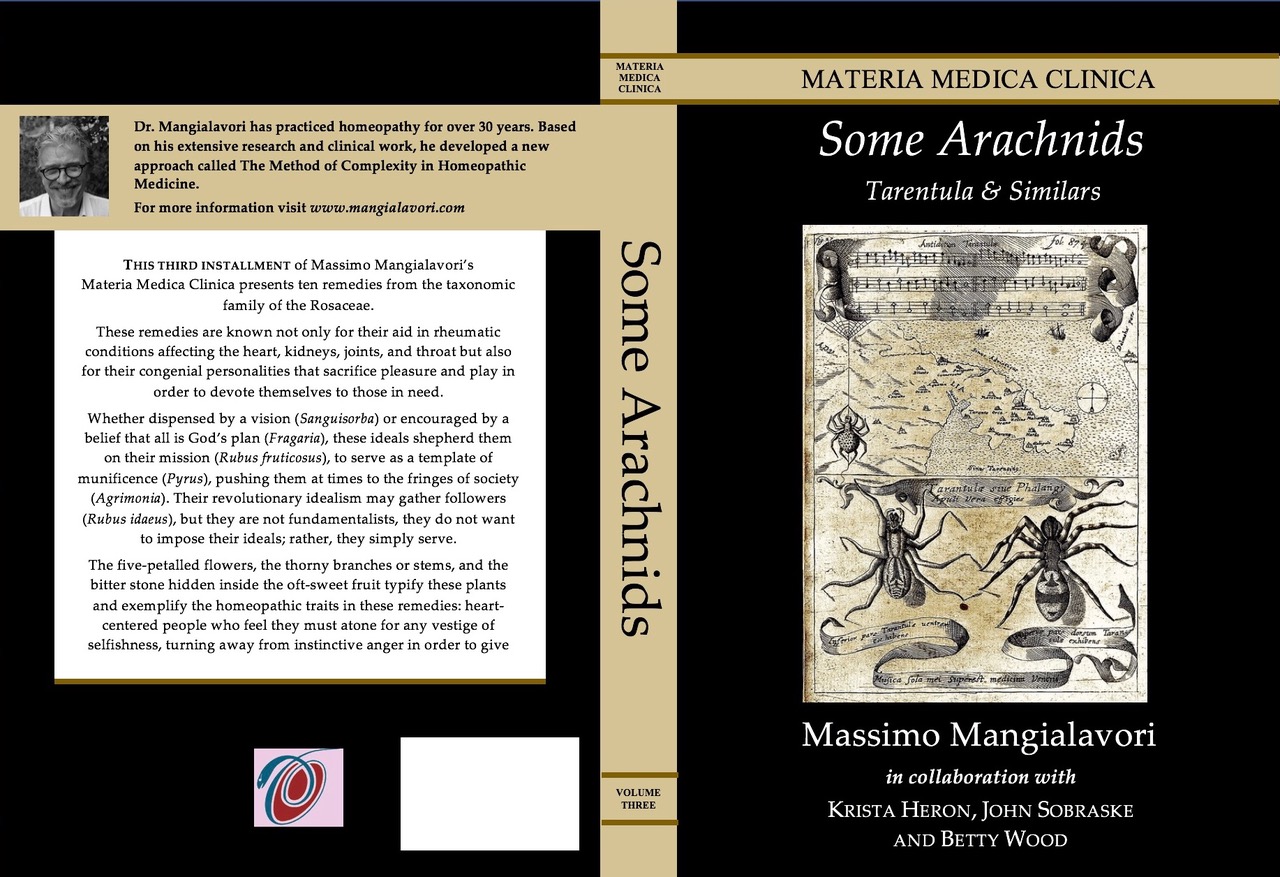
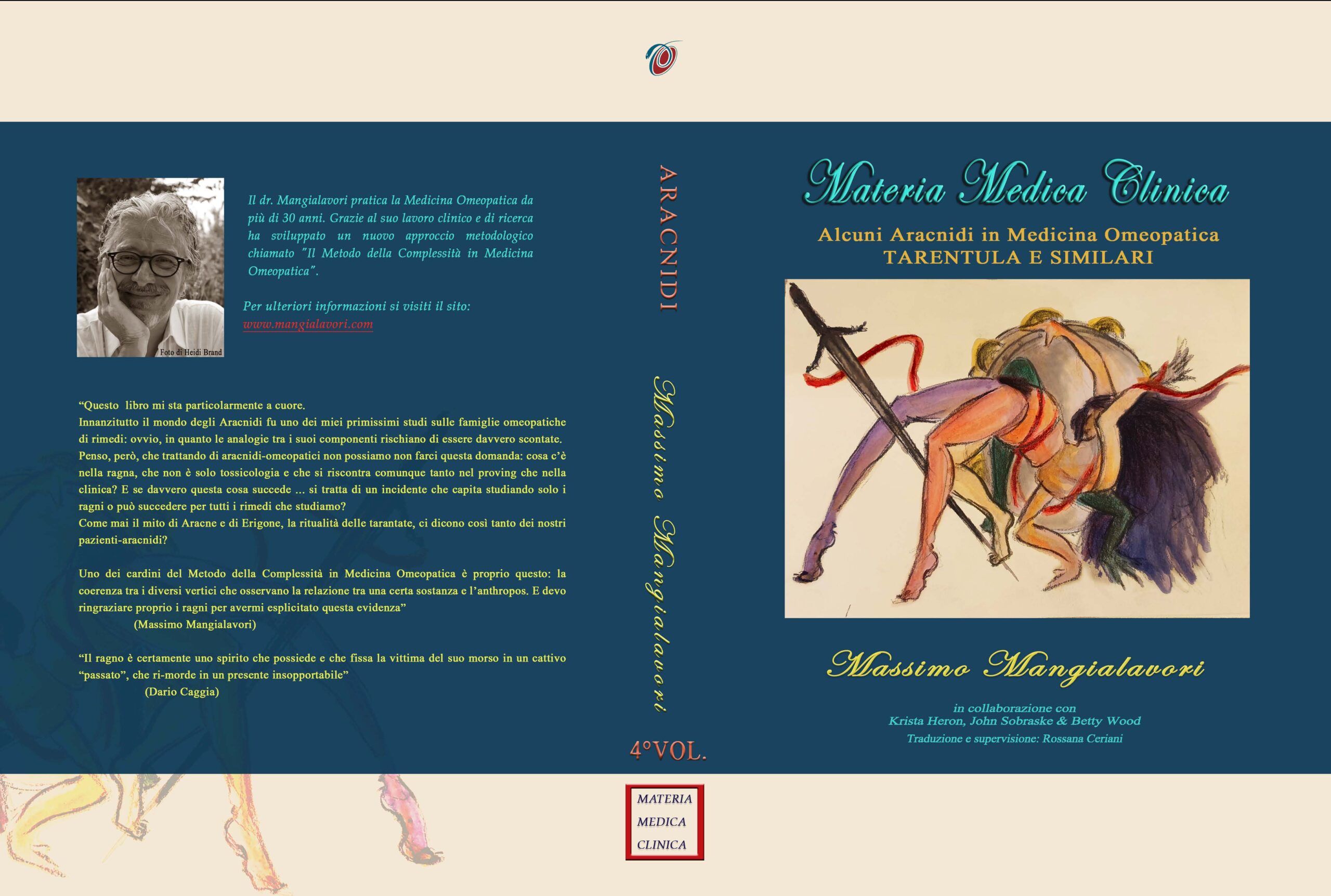
Some Arachnids: Tarentula and similars
One of the cornerstones of the Complexity Method in Homeopathic Medicine is precisely the study and research of coherence between the different vertices through which we observe the relationship between a certain substance and the Anthropos. I must thank spiders for making this clear to me more than 30 years ago when, together with Hans Zwemke, we published “Bitten in the soul”: the first homeopathic medicine book dedicated to an in-depth study of these cute little creatures in our pharmacopoeia.
There are so many similarities between their way of life, the symbolism that describes them from our anthropocentric perspective, the myth of the phallic spider mother, the medical anthropology of the tarantate so wonderfully described by Ernesto De Martino, and our observations as homeopaths.
The sense of persecution, the transgressive and oppositional behaviour, the periodicity, the relationship with rhythm and the dissonance between the patient’s time and that of the world around them, the need for an audience forced to suffer and adapt to their acting-out, the proverbial restlessness, the uncoordinated, choreiform motor skills, the paroxysmal suffering that is only partially curable through the patient’s own codes and not those of conventional medicine, the capacity for extreme and almost non-stop performances. Not to mention what for years was called “hysteria”: a pathology that does not exist on an objective clinical level, but is subjectively so painful as to be paralysing.
How intriguing it is to recognise these similarities: nothing to do with the toxicology of the real poison, but so much more to do with a symbolic intoxication!
Special thanks to Jeremy Sherr for his introduction to the text.
Natural history, materia medica, clinical cases with long follow-up and authorised by the patient, repertory additions, differential diagnosis. Summary of the fundamental themes, characteristics, coherent groups of symptoms, motifs, pathologies and syndromes successfully treated in my personal case history for the following remedies:
1) Tarentula hispanica
2) Aranea diadema
3) Latrodectus mactans
4) Theridion curassavicum
5) Mygala lasiodora
6) Aranea ixobola
7) Loxosceles reclusa
8) Tela aranearum
9) Buthus australis
10) Androctonos amoreuxii hebraeus
Some Arachnids: Tarentula and similars
One of the cornerstones of the Complexity Method in Homeopathic Medicine is precisely the study and research of coherence between the different vertices through which we observe the relationship between a certain substance and the Anthropos. I must thank spiders for making this clear to me more than 30 years ago when, together with Hans Zwemke, we published “Bitten in the soul”: the first homeopathic medicine book dedicated to an in-depth study of these cute little creatures in our pharmacopoeia.
There are so many similarities between their way of life, the symbolism that describes them from our anthropocentric perspective, the myth of the phallic spider mother, the medical anthropology of the tarantate so wonderfully described by Ernesto De Martino, and our observations as homeopaths.
The sense of persecution, the transgressive and oppositional behaviour, the periodicity, the relationship with rhythm and the dissonance between the patient’s time and that of the world around them, the need for an audience forced to suffer and adapt to their acting-out, the proverbial restlessness, the uncoordinated, choreiform motor skills, the paroxysmal suffering that is only partially curable through the patient’s own codes and not those of conventional medicine, the capacity for extreme and almost non-stop performances. Not to mention what for years was called “hysteria”: a pathology that does not exist on an objective clinical level, but is subjectively so painful as to be paralysing.
How intriguing it is to recognise these similarities: nothing to do with the toxicology of the real poison, but so much more to do with a symbolic intoxication!
Special thanks to Jeremy Sherr for his introduction to the text.
Natural history, materia medica, clinical cases with long follow-up and authorised by the patient, repertory additions, differential diagnosis. Summary of the fundamental themes, characteristics, coherent groups of symptoms, motifs, pathologies and syndromes successfully treated in my personal case history for the following remedies:
1) Tarentula hispanica
2) Aranea diadema
3) Latrodectus mactans
4) Theridion curassavicum
5) Mygala lasiodora
6) Aranea ixobola
7) Loxosceles reclusa
8) Tela aranearum
9) Buthus australis
10) Androctonos amoreuxii hebraeus
Some Arachnids: Tarentula and similars
One of the cornerstones of the Complexity Method in Homeopathic Medicine is precisely the study and research of coherence between the different vertices through which we observe the relationship between a certain substance and the Anthropos. I must thank spiders for making this clear to me more than 30 years ago when, together with Hans Zwemke, we published “Bitten in the soul”: the first homeopathic medicine book dedicated to an in-depth study of these cute little creatures in our pharmacopoeia.
There are so many similarities between their way of life, the symbolism that describes them from our anthropocentric perspective, the myth of the phallic spider mother, the medical anthropology of the tarantate so wonderfully described by Ernesto De Martino, and our observations as homeopaths.
The sense of persecution, the transgressive and oppositional behaviour, the periodicity, the relationship with rhythm and the dissonance between the patient’s time and that of the world around them, the need for an audience forced to suffer and adapt to their acting-out, the proverbial restlessness, the uncoordinated, choreiform motor skills, the paroxysmal suffering that is only partially curable through the patient’s own codes and not those of conventional medicine, the capacity for extreme and almost non-stop performances. Not to mention what for years was called “hysteria”: a pathology that does not exist on an objective clinical level, but is subjectively so painful as to be paralysing.
How intriguing it is to recognise these similarities: nothing to do with the toxicology of the real poison, but so much more to do with a symbolic intoxication!
Special thanks to Jeremy Sherr for his introduction to the text.
Natural history, materia medica, clinical cases with long follow-up and authorised by the patient, repertory additions, differential diagnosis. Summary of the fundamental themes, characteristics, coherent groups of symptoms, motifs, pathologies and syndromes successfully treated in my personal case history for the following remedies:
1) Tarentula hispanica
2) Aranea diadema
3) Latrodectus mactans
4) Theridion curassavicum
5) Mygala lasiodora
6) Aranea ixobola
7) Loxosceles reclusa
8) Tela aranearum
9) Buthus australis
10) Androctonos amoreuxii hebraeus